A# m6 — Sitar
Every CGCGC voicing of A# m6 — a Western reference chart for the sitar's long neck, fingered and playable.
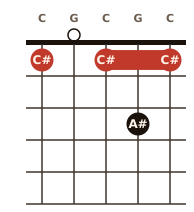
A# m6 stacks A# – C# – E# – F##. Each chart below places those tones on the Sitar's CGCGC strings and names the fret and finger holding each one — tap a chart to hear it.
Hindustani classical music does not move through chords and scales the way Western harmony does — a performance moves through a single raga, one melodic line, over a held drone rather than a chord progression. A chord chart on this page is a Western convenience: useful for finding where a set of pitches sits on the neck, and honest about being nothing more than that.
The sitar's own intonation bends beyond what fifteen fixed frets can show: meend, the pull across a fret that raises a pitch without a new finger position, is the technique no fret diagram can draw. Treat every chart here as a 12-TET reference position, not the sound a sitarist actually makes.
A sitarist reading this chart is borrowing it, not living in it: the useful next step is finding these same pitches inside a raga's own ascent and descent, not holding them down as a block.