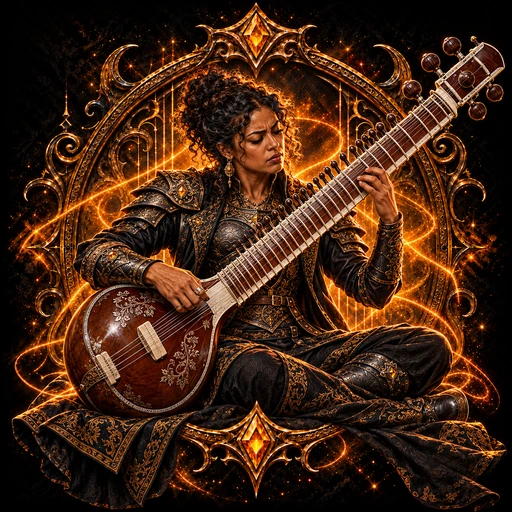
The Sitar, Raga First
Every page here treats the sitar honestly: which thaat could hold a raga on this Sa, what each string calls itself in sargam, and where the 12-TET chart stops being the whole truth.
Free, playable references for the sitar — every 12-TET chart derived for the CGCGC strings, with the raga-first thaat frame alongside, and every number recomputed in CI.
One Neck, Ten Thaats
One instrument covered deeply rather than four covered thinly: the five-string sitar, plus the ten classification frames that sort its ragas.

Sitar
- Tuned C–G–C–G–C — only Sa and Pa ring open
- 5 strings on one long fretted neck
- The classical solo voice of Hindustani music

Bilawal Thaat
- All seven swaras shuddha
- The reference thaat, zero komal or tivra
- Every other thaat is measured against it
Kafi Thaat
- Komal Ga and komal Ni
- Two swaras flattened from Bilawal
- Derived offset by offset, not by ear
Bhairav Thaat
- Komal Re and komal Dha
- A different pair, the same count as Kafi
- The morning-raga thaat's frame
What Lives Here
Chords
Every key and quality charted string by string, frets and fingers named — a 12-TET reference, honest about being borrowed.

Scales
Western scale maps across five strings with every root marked — a reference shelf beside the raga-native thaats.

Fretboard Explorer
Light up any set of notes across the CGCGC neck — small enough to actually memorise.
Progressions
Each key's Western chord family, from Sa — a reference layer this instrument's own music does not use.

Exercises
Daily string-crossing and timing drills with tab and playback built in.

The Ten Thaats
Bilawal, Kafi, Bhairav, and seven more — every swara and komal/tivra count recomputed in CI, none of it typed by hand.

Chord of the Day
The network's shared daily pick — read from Sa, checked against the ten thaats.

Free Tools
Tuner, metronome, palette builder — in the browser, no sign-up.
How It Works
Start From a Root
Pick a root and a quality — every charted voicing arrives on the CGCGC strings with its frets and fingers named, drawn for this neck and no other.
Set the Root as Sa
Charts name what each string carries; the thaat tables say which swara it calls itself and which of the ten classification frames could hold a raga built from it.
Hear the Difference
Playback on every voicing, drills for the picking hand, and ten computed thaats to compare — a 12-TET chart is a place to start, not the raga itself.
The Raga-First Home
Sitar Warrior is the Warrior Network's deep home for the sitar. Hindustani classical music does not move through chords and scales — it moves through a single raga, and a raga is classified, not defined, by the thaat it sits under. So this site is built honestly around that fact: 12-TET chord and scale charts stand as a labelled Western reference layer, the thaats engine carries the real classification frame, and every derived number — swara names, komal/tivra counts, board positions — is recomputed in CI rather than typed in.
Go Deeper
Guides and references worth bookmarking: the ten thaats · Bilawal · Kafi · Bhairav · the daily Sa reading · the metronome · all tools. Want the same chord on guitar, ukulele, or any of 20+ string instruments? Our sister site String Warrior compares them all — this site goes deep where that one goes wide.
Sitar Questions, Answered
More on the full FAQ page.
- What makes Sitar Warrior different from a general chord site?
- Every page leads with raga-first honesty: chord and scale charts are labelled as a 12-TET reference layer, not the instrument's own music, and the ten-thaat classification system is computed from the registry rather than copied from a book.
- What tuning does this site use?
- C–G–C–G–C, modeled as five simplified main strings — only two pitch classes ring open (Sa and Pa, a perfect fifth apart), three C strings in rising octaves and two G strings an octave apart, and no open major triad exists on this tuning.
- I play guitar. Will any of this carry over?
- The 12-TET chord and scale charts will look familiar, but the sitar's own vocabulary — raga, thaat, sargam, meend — has no guitar equivalent. Start with the thaats engine if the goal is the instrument's real music, not a Western substitute for it.
- Do I need to read music to use this site?
- No. Everything here is charts, tab, and playback — fret numbers, swara names, and audio on every voicing and thaat position, so the ear can check a shape before the fingers commit.
- Does any of this cost money?
- No — every chart, thaat table, drill, and tool on Sitar Warrior is free, with no ads, no account, and no upsell waiting at the end.